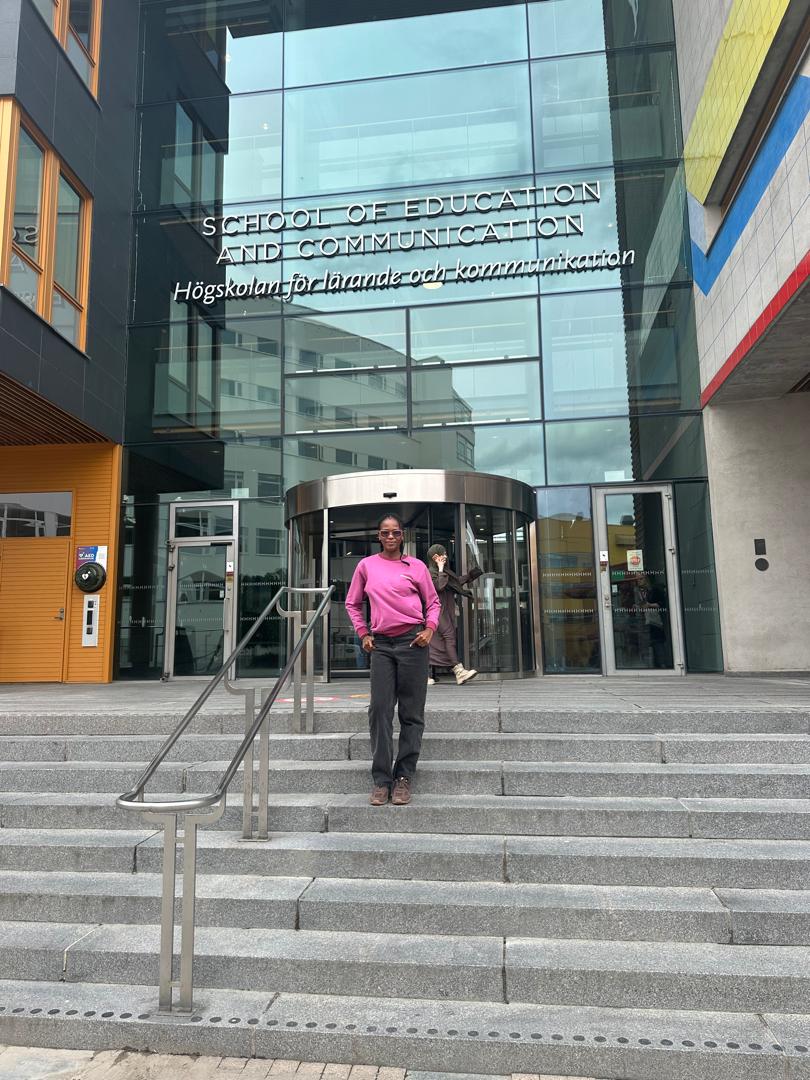
Hej! They say the best journeys are the ones that take you somewhere unexpected, and mine led me to Jönköping, Sweden, where I discovered new perspectives, challenged myself, and created memories I will carry with me forever. I’m Enam Awo Ayekpley, a Communication Studies student at the University of Ghana. In the spring of 2026, I had the incredible opportunity to participate in an exchange programme at Jönköping, an experience I am still unpacking to be honest.
I was hopeful about 2026. I would finally be graduating with my master's degree, hopefully find a good job, and somehow figure out adulthood. A study abroad programme was nowhere in my plans. Then my phone rang. I had been nominated for a student exchange programme.
I remember barely asking any questions. Which country? Which university? How long? None of that seemed important because, surely, this couldn't really be happening. It wasn't until I was invited to the University's International Programmes Office that I allowed myself to believe it was real. The process wasn’t without its challenges, and frankly until my visa landed in my hands, two days before I travelled, I still hadn’t allowed myself to get excited.
The opportunity came through my Advertising course in the Department of Communication Studies (DCS), after my lecturers, Prof. Abena and Dr. Jade had nominated me and a few of my colleagues to participate in an exchange programme at Jönköping University in Sweden. The programme, facilitated through the Study Abroad Office within the International Programmes Office, is part of a longstanding partnership between the University of Ghana and Jönköping University.
Looking back, the nomination felt especially meaningful because advertising had been one of the reasons I chose to pursue Communication Studies in the first place. One of the highlights of my master's programme was working with my group to develop a campaign for the University of Ghana Enterprise Limited and pitching it before their executive board. Seeing our ideas accepted by a real organisation was incredibly rewarding. Learning later that my participation in that same class had led to my nomination felt like the best kind of validation.
Then came Sweden. If there is one lesson I can offer future exchange students, it is this: Google the temperature, not the season.
Typing "spring in Sweden" into Google had convinced me that light jackets would be enough. Landing at Gothenburg Landvetter Airport quickly proved otherwise. The cold hit me so hard I was convinced I had made a terrible packing decision. Those few hours waiting for the bus to önköping were the one and only time I missed the Ghanaian heat.
Thankfully, that was the only shock that lasted.
I joined the School of Education and Communication at Jönköping University, where I took a course in Communication Theories and Strategies as part of a broader Communication and Media Studies programme. Many of the concepts were familiar, from classical communication theories to strategic communication, corporate social responsibility, and stakeholder engagement. What differed was the teaching style. Classes met only two or three times a week, but each session lasted several hours and was highly discussion-based, giving us plenty of time to explore ideas in depth.
The lighter class schedule also gave me the opportunity to experience life beyond the classroom.
I quickly fell in love with fika, the Swedish tradition of taking a break over coffee and pastries. My personal favourite was the kardemummabulle, a soft cardamom bun that quickly became my excuse to visit cafés more often than I probably should have.
As someone who is naturally reserved, I expected to spend the first few weeks quietly observing. I was also the only student from the African continent in my class, so I assumed I might feel out of place. Instead, I found myself contributing to discussions almost immediately. I challenged ideas, defended my own, and enjoyed debating with classmates whose perspectives had been shaped by cultures very different from mine.
One seminar in particular has stayed with me. We were asked to consider a fictional scenario in which a private company wanted to build data centres in a municipality while donating laptops to a local public school. On the surface, it seemed like an act of corporate generosity. However, the laptops had been configured with filters that prevented students from accessing online information about allegations against the company. I was assigned the role of a student activist arguing against the company's actions.
What followed was a genuinely engaging classroom discussion. Students argued from the perspectives of corporations, local government, community members, activists, and the media. We debated transparency, public trust, stakeholder responsibility, and whether corporate social responsibility could exist without genuine accountability. It was communication theory brought to life.
It also made me realise how well DCS had prepared me. Anyone who has studied Communication Studies knows the rhythm of the department: weekly assignments, group work, presentations and practical projects. At one point, presentations felt like my greatest fear. I dreaded standing before my classmates, hoping my voice wouldn't shake.
Somewhere between the first presentation and the fifth, without even noticing. I had learned how to organise my thoughts better and speak more confidently.
That became clear during one discussion in Sweden. I stood in front of classmates from different countries, explained my position, responded to questions, and continued the debate. I kept waiting for the nerves to arrive, for the racing heartbeat I had grown so familiar with and nothing. That was the moment I realised the Department of Communication Studies had done more than teach me communication theories. It had quietly transformed the way I communicated.
When my final examination ended, I asked my Swedish friend Yasmin to take one last photograph of me in front of the School of Education and Communication. It was a simple picture, but it captured something difficult to describe.
The Japanese have a phrase, mono no aware, an awareness of the beauty and sadness that comes with fleeting moments. Standing there, I knew the exchange had come to an end, and that made me appreciate it even more. It was bittersweet, not because I wanted to leave, but because I realised how much I had grown in such a short time.
I returned to Ghana with more than photographs, souvenirs, and a new appreciation for cardamom buns. I returned with the confidence that the education I received at the Department of Communication Studies could stand alongside that of students from anywhere in the world.
The exchange reminded me that communication is ultimately about people. Whether in a lecture hall in Legon or a seminar room in Sweden, the ability to listen, question, connect, and communicate across cultures is what truly matters.
For students considering a future at the Department of Communication Studies, opportunities like this are proof that the classroom can take you much further than you imagine. The training is demanding, the presentations are relentless, and the assignments sometimes feel endless. But one day, you may find yourself halfway across the world, confidently contributing to conversations you once thought were beyond you.
And in that moment, you'll realise every presentation was worth it.